Thursday, October 11, 2018

Memories from Clyde S Jennings Elementary School

What do you remember about elementary school?
I remember the smells...the smell that would envelop me each time I entered the building. I don't exactly know what that smell was, but I believe it to be a combination of construction paper, glue, books, and maybe even the concoction that was used to clean the floors each evening. I remember going back to Jennings School as a college student, and upon entering the first thing I noticed was that smell. I brought me right back to kindergarten.

Lately I've been reflecting on the other memories I carry dear with me from those K-6 years.
What are the memories that float to the surface whenever I think back?

Well, here they are...


  • Big Books in Kindergarten and the excitement of wondering what adventures Miss Bailey would read share from the characters of alphabet island
  • 3rd grade plays...we did two that year with Mrs. Smith...The Mystery of the Gumdrop Dragon and another math mystery. The name of the math play escapes me, but I remember that one character was Mr. Addition, Ms. Subtraction, etc. 
  • In 4th grade, Mrs. Adams guided us as we built a tepee in the classroom out of two-by-fours and bulletin board paper. We were able to read in there if we were lucky enough to get first choice of reading spots for the day. 
  • Also in 4th grade, we used milk cartons to create puppets and then wrote and performed plays in groups. We even got to design the scenery for our productions. 

  • In 5th grade, we actually got to publish our writing into books! This was not a common practice in the 70s, and I was so excited to not only write, but illustrate and publish my stories with Mrs. Gerrity. 
  • I also remember creative writing time in 5th grade, where Mrs. Gerrity would read a story-starter and we would get to finish the adventure. I loved creative writing!
  • Finally, I remember all of the books. Where I went to school, students had the chance to read every day. Not just the books we were assigned as a "bluebird" or "robin", but also our own self-selected books from the class or school library and even books we brought in from home. SSR time was our choice time for reading.
Me in first grade ⇨⇨⇨   


When I look at the things that inspired and left me with lasting memories of my early schooling, nowhere do I mention tests, homework, textbooks or book reports. In fact, the things I enjoyed most were times when I had student choice through my reading, writing, spots for reading, and creating. 
I remember the relationships and how my teachers made me feel. Mrs. Adams bought our entire class McDonalds one day for lunch! Several of my teachers actually walked us to McDonalds in early spring to enjoy Shamrock Shakes!
I remember teachers who made me feel special...teachers who I know cared about me. 

My walk down memory lane reinforced what I already know is best for kids and their success in school:
It's all about relationships
It's all about student voice and choice
It's all about student engagement


Tuesday, September 25, 2018

Kindergarten...Remember That's It's Supposed to Be About the Journey


Jennifer Serravallo published a blog this week titled "Teaching While Parenting: On Kindergarten Readiness". In the article, she shared the different but intentional journeys her two daughters took on the road to kindergarten readiness.

What stuck with me was the following:

"I support a redefinition of kindergarten readiness. I believe in open-ended, hands-on, student-driven play to help them be ready, reading them lots of stories and teaching them to tell their own stories, and working with numbers in real-world ways."

https://medium.com/@heinemann/teaching-while-parenting-on-kindergarten-readiness-56605d614eb2


As a former first grade teacher, and now a supervisor of elementary language arts instruction, I know the importance of kindergarten readiness. However, I also firmly believe in the importance of developmental appropriateness, and in an era of "push-down curriculum", more and more is being expected from our 5 and 6 year olds. 

Here is an analogy I share often with preschool and kindergarten parents. I don't remember the origin of this, so I am unable to credit anyone.

When a child is learning to walk, the process can begin as early as nine months of age or as late as 14 months of age. We've all watched a child in their journey towards mobility, and one thing I think we can agree on is that the process cannot be rushed. If you take a child who is not yet ready for their first steps, and stand them up, they will fall down. No matter how many times you repeat this process, the child will tumble as their bodies are not yet ready to support this new progression. Conversely, I know that you can't get in the way of child who is ready and determined to take those first steps. Look out, because here they come!

My daughter walked at nine months of age, and her cousing didn't walk until fourteen months. They are now both adults, and no one has ever looked at them as said, "She is a good walker! She must have been an early walker! Oh, look at him. I bet he didn't walk until after he turned one." 

The answer is a resounding no. They each walked when they were developmentally ready to do so, and it wasn't the result of pushing the process along or helping my daughter to walk early. Both children had bouncy seats and walking toys to support them along their journey, but "extra practice" was not the difference.

This analogy also applies to reading. We must provide rich experiences on the road to reading, through exposure to books and words and print, but the pieces will come together on their own time. For some children this is in Kindergarten, but for most it occurs in grade 1. For a few students it may not happen until second grade. The important thing is for us as educators to be there to support our students, picking them up when they fall down.

Now that brings me to the importance of play and other experiences as Jennifer spoke about in her blog. I firmly believe that Kindergarten needs to continue to be a place of readiness.

It's a time to develop important social-emotional and executive function skills.

A time to play, wonder, explore and question.

A time to make friends and learn to understand differences.

A time to follow directions, cut, color, paint and glue.

A time to learn about numbers and patterns in the world through meaningful, real-life experiences.

A time to draw and learn how to properly hold a pencil as they practice forming letters and numbers.

It's a time to rhyme, learn letters and their corresponding sounds, and concepts about print.

All of this is in preparation for learning to read, write, and develop number sense in first grade and beyond. Accelerating this process will not produce "better students", but can impact their sense of wonder and lead to frustration for those who are not developmentally ready.

We need to stop pushing down curriculum, but work to make experiences developmentally appropriate and rich with real-world applications.

Let them play, for it is through this that a true learner will emerge. One who never stops wondering, questioning, and persevering.


Wednesday, September 19, 2018

Shifting My Lens...Looking At ACEs In Our Students


At the start of my summer, I participated in #EdCampVoice, a 24-hour EdCamp using Voxer. One of the groups I joined was title "Trauma Informed Instruction". I was interested in this topic because I have been noticing more and more students in our schools who have experienced trauma in their lives that I could never even image. In the youngest of the grade levels I supervise, much of what these children have been experiencing has been manifesting itself in behavioral difficulties. What I've been most concerned about lately is that that our amazing teachers, who would do anything to support and care for their students, didn't have an understanding of why some children were behaving in specific ways, and more importantly, what to do about it. Our schools seem to be receiving some students we are ill equipped to support.
Through this EdCamp group, I heard about ACEs (Adverse Childhood Experiences) for the first time. This was a mind-changing discovery for me. ACEs outlines specific childhood experiences, 10 to be exact, which have been strongly correlated to long-term health risks, violence, and other life effecting consequences. The more of these traumatic experiences a child has faced, the greater likelihood their adult life is affected.
There is a great deal of information available about ACEs and several long-term studies that have been conducted, and I will link some of these resources below.
Getting back to my EdCamp experiences and ACEs, you can imagine what a lightbulb moment this was for me and my concern about the growing number of students having social and behavioral difficulties in our classrooms.
Fast forward to August, when I was fortunate to attend a screening of the documentary "Resilience" in my school district. This documentary shared studies conducted on ACEs and I was touched by the stories shared by people who have experienced a high number of ACEs.
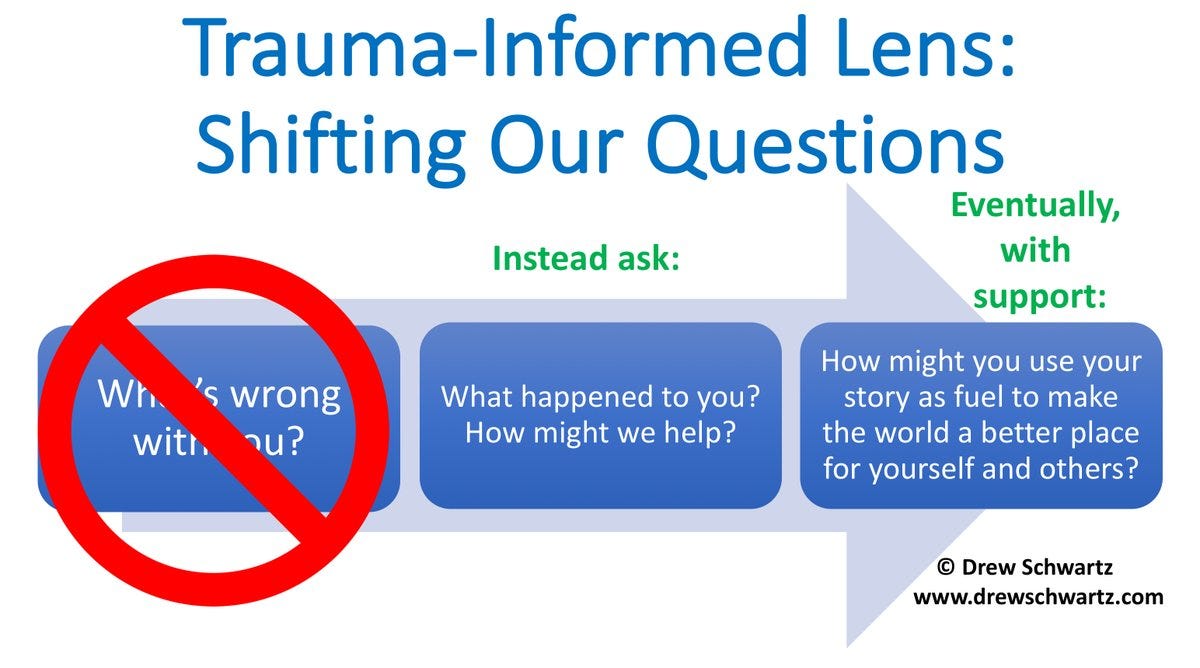
My lens has changed this year. Instead of looking at a child having a meltdown or behavioral difficulty in school with the thought of "why are you doing this?", I have shifted to "what could have happened to you"? Spending the time to get to know students, their background, and even past traumatic experiences, can open the gate to support and understanding for our students. Sometimes our students can ask for help in the most unusual ways. It is our job as educators to make sure our students feel safe and secure, because we know learning can't happen without that. We also have a critical role to support our students, and realize we can never know all that they have experienced outside of our classroom or school building. We can change the path for students who have been affected by ACEs...it is our obligation.

Image result for students of trauma

There is so much more for me learn about this, and information can be readily found. Here are just a few links to get you started if learning about ACEs is new for you.

https://www.cdc.gov/violenceprevention/acestudy/index.html 
https://www.edutopia.org/article/when-students-are-traumatized-teachers-are-too 
Find your own ACEs score: https://acestoohigh.com/got-your-ace-score/


RESILIENCE: The Biology of Stress and the Science of Hope - Trailer


Monday, September 10, 2018

Summer Learning... I want all the things


Summertime...educators stand at the end of another school year, which in my case is always June 30, and look ahead at the weeks stretching in front them with hope and anticipation.
We think about all of the things we want to accomplish, both personally and professionally. If you're like me, the list likely consists of a combination of things like "clean out and organize my closet" to reading a growing list of the latest professional books, spending time with family, and just getting some R & R. 

In other words, we want to do what my friend Elizabeth's daughter calls "all the things" during our time away from school and our students as we recharge for a new school year. 
The problem for me is that my list usually far exceeds the time I have actually have available. 
I started the summer joining 6 professional book studies. Yes, I definitely overextended myself, but definitely with the best of intentions. 

Communicating daily with my #4ocfpln guided my learning this summer, through daily conversations equal to the best professional development sessions I've attended, along with A LOT of professional and personal reading, a blog challenge, and even a FitBit challenge. 

Last month, in the middle of August, I was fortunate to once again organize and host a 3-day summer institute in my district. The teachers who attend this conference are coming on their own time, during their summer hiatus. These are teachers who want to learn and refesh for the upcoming school year, and I am always warmed by their passion and enthusiasm for their learning. These teachers also want to do "all the things" during their summer, and are including their own professional development as part of that. 

Summer gives us a time to focus on what Jimmy Casas calls "life fit", while recharging and learning something new to implement during the new school year. As educators, we are fortunate to have this time. 

Did you attempt "all the things" this summer?

I certainly did, although I never did clean out my closet. 

My "Life Fit" this summer...

Family 💗

Professional Learning 😃


Sunday, August 19, 2018

Empowering Teachers Towards Risk-Taking

In What Great Principals Do Differently, Todd Whitaker states "it's people, not programs".

I truly believe this statement. As an instructional supervisor, how do I support and empower teachers to make the best instructional decisions for their students?

That is a question I continually ask myself and strive to accomplish.

I am currently reading my collegue Jay Billy's new book, Lead With Culture, and have been participating in a Voxer book study. The following excerpt from the book states exactly what I've been thinking:

"But is is our responsibility to make sure teachers and students feel empowered to go off script. We must also create an environment where the teachers think of themselves as learners and are not afraid to take chances and ask questions and push learning and teaching to the next level."

Through the reading of this book along with the discussions in the book study group, I have stopped to ask myself the following:


  • What am I modeling to enourage and support learning and risk-taking?
  • Am I sharing this with staff?
My answers to these questions may be the answer to my initial question posed above. I need to be the risk-taker my teachers see, modeling and sharing my successes and failures. I do take risks and work to share my learning with staff, but I need to be more intentional about it, becoming more vulnerable through the process. 

So as I reflect on the past few months and my start of the 18-19 school year, I am pledging to be more transparent and intentional in sharing my learning and modeling risk-taking for staff. Through this, my goal is to further empower teachers to take chances, go off script, and do what they know is best for students. 


Friday, July 13, 2018

Reflecting on 25 Years...

Friday, June 29, 2018 marked the end of my 25th year in education.
25 years...wow...
I can still remember standing in that first grade classroom, desks neatly arranged with carefully placed name tags, alphabet strips, and a 100s chart for each student on top. The bulletin boards were adorned with fresh paper and decorative borders, and a large carpet marked the area where my class would meet together for morning meeting and daily lessons. A calendar board was marked with September, and contained empty charts to graph the weather and count the days of the school year.

I felt excited and nervous at the same time. In just a few minutes I would walk down to the gym to meet my students, and I would officially be a teacher. I specifically remember thinking that in just a few short hours, my first day of teaching would be complete, and my journey would have begun.

It's been 25 years and my path has been a relatively positive one. I can still name every student from that first class...not as many from my last class. My first students are now 31-33 years old.

My journey has not varied much. I've been a 1st & 2nd grade teacher, K-3 reading specialist, and elementary curriculum supervisor across two school districts. Change seems to find me, and I only make a change if I feel it will be best for students, myself, and my family.

As I've been approaching this milestone, I have taken some time to reflect on my years in education, specifically my own professional growth through the journey I have taken. Although I could write volumes about my experiences, students, triumphs and challenges, instead I would like to share my most recent educational journey.

Two years ago, I was feeling very complacent, which is not a feeling any educator wants to feel. I was loosing sight of my focus, my "why". I had been in my current position for 8 years, and had come in ready to facilitate change, empower teachers, and most importantly for the success of the students. Was anyone even listening to me anymore?

New Year's Day 2017 I decided to take the #OneWord challenge. Choosing a word was easy: INSPIRE. I wanted to be inspired again and to also inspire my staff. INSPIRE became my motto for the year and served to guide my journey.

My first step began with writing a monthly newsletter for staff. My district had purchased me a Smore newsletter subscription, but I had yet to use it. I dove in and wrote my first newsletter, newly title "Literacy Lowdown", with a focus on Close Reading. Once shared with my staff, it received some positive feedback and a few teachers implemented the strategies or resources I shared. I continued to publish a new Smore each month for the rest of the school year, with focuses on independence and accountability during reading workshop, independent reading, questioning, student engagement, and reflection. While I chose the focus for the each newsletter based on observed teacher need, I found myself diving deeper into each topic and learning more along the way.

During the summer of 2017, I attended the National Principals Convention in Philadelphia. I basically begged my district to send me to this event, and since it was only a car-ride away, I was able to go. This is where I felt the fire of inspiration spark again inside me. I left feeling completely energized and of course inspired as an educational leader. I purchased and read Kids Deserve It, Lead Like a Pirate, and The Four O'clock Faculty after meeting and hearing Todd Nesloney, Shelly Burgess and Beth Houf speak at the convention, and meeting up with Rich Czyz.

I started the 2017-18 school year more inspired, but still looking for more. I choose my new #Oneword for 2018 with the help of staff, and my motto for this new year was INTENTIONAL.

In late January 2018, I joined a Voxer book study group to read Rich Czyz's book The Four O'Clock Faculty. This is the move that has changed my life, literally. It has resparked my fire as an educator and renewed my passion for children and learning. My trajectory as an educator has been forever changed.

Talking about this book each day with this Voxer book study group introduced me to an amazing group of educators from across the country. This group was made up of educators ranging from those in the field for just a few years to over 30 years and stretched from the Pacific Northwest through the Great Plains, the heart of Texas and along the east coast.

Being a part of this book study began to push my thinking and reignite my passion for learning. Since "meeting" this group of educators, who have since become my PLN/F, I have accomplished the following:

  • I have read more educational books and articles than in recent years combined. Not that I wasn't reading and learning all along, but definitely not at this rate or level.
  • I have doubled my followers on Twitter through chats and have made connections that I learn from every day. Twitter went from being a place I lurked on a few times a week to a place where I connect daily.
  • I attended my first two EdCamps. 
  • I implemented the first #CoffeeEDU chats in my district and attended local chats.
  • I organized the first Book Tasting where 80 staff members came to choose their summer educational reading. 
  • I started this blog.
  • I started listening to Podcasts. The radio is NEVER on in my car anymore. I'm either voxing or listening to a podcast. Canceled my satellite radio service!
  • I am facilitating a district leadership book study this summer.
  • I've learned about the latest tech tools to enhance student learning and are supporting staff in implementation of Flipgrid, Newsela, BookSnaps, Buncee and so much more. 
  • I have challenged staff to "shift" one thing in their practice for the new school year. Published a Smore about it: https://www.smore.com/g90jw 
  • I have set a goal for the new year to start presenting PD outside of my district again and maybe even host a Twitter chat or two. 
This is not meant to be a brag list of any sort, but to further illustrate the importance of finding a PLN, a group that will push your thinking every day and make you a better person. Although our book study ended in February, we have stayed together as a group and continue to talk every day and are deeply connected on both an educational and personal level. They are my tribe. 

My 25-year journey has been rich and filled with many amazing educators along the way. I am grateful for the experiences, ups and downs, and most of all the learning and the children. It's really all about the kids.

Here's to 25 more...well, maybe 15-20?

Thank you to my #4ocfpln! 

Sunday, June 24, 2018

Countdown to Summer...or not

I was walking through one of our schools on the second to last day of school, when a fifth grader passed me and made a comment.
"It looks empty in here."
She kept walking slowly as we briefly conversed about things coming down off of hallway and classrooms walls in preparation for summer break.
"It makes me feel lonely"
I asked her if she wanted the school year to come to a close, and she shook her head no before turning the corner and heading out of my site.

We do it every year. Whether it's a classroom countdown visually displaying the days until summer break, with days getting checked off or erased as the last day of school draws closer, or in the novelty t-shirts worn by staff on the final day of classes for students.

What about the students who don't want the school year to end?
What about the students who relied on your warmth, kindness, encouragement, and consistency in their lives?
What about the students who only feel safe when they are at school?
What about the students who only get a full meal at school?
And what about the students who just aren't ready to say goodbye to a favorite teacher?

It's easy to forget as we get swept up into the busyness that comes with closing out a school year, but some of our students are not looking forward to being away from school for the summer.

Think about it...if you've spent the year establishing a classroom environment; a close-knit community where students are engaged, growing, exploring, and learning every day, why should they want to leave this?
We work to make school, as Dave Burgess says, a place where students are running to get in every day...and then tell them they won't be coming for 2+ months...and they should be happy about this?

How would you feel if someone was counting down the days until they weren't going to see you every day?

I do believe that these traditions are essentially traditions; things we've "always done", but it's time to think about how this makes our students feel.

Let's change the way we celebrate the end of the school year and put our kids first.